The Data Problem Holding Robotics Hostage
AI can reason. But it still can't act.
This simple statement from the SeeSaw team cuts to the core of a monumental challenge in embodied AI. The most advanced language models can write poetry, but a robot struggles to reliably fold a shirt. The bottleneck isn't intelligence; it's data—specifically, vast, diverse, and natural datasets of humans performing physical tasks.
SeeSaw, launched in October 2025 as Subnet 5 on the BitRobot Network, is a direct assault on this scarcity.
A Gamified Pipeline for Real-World Data
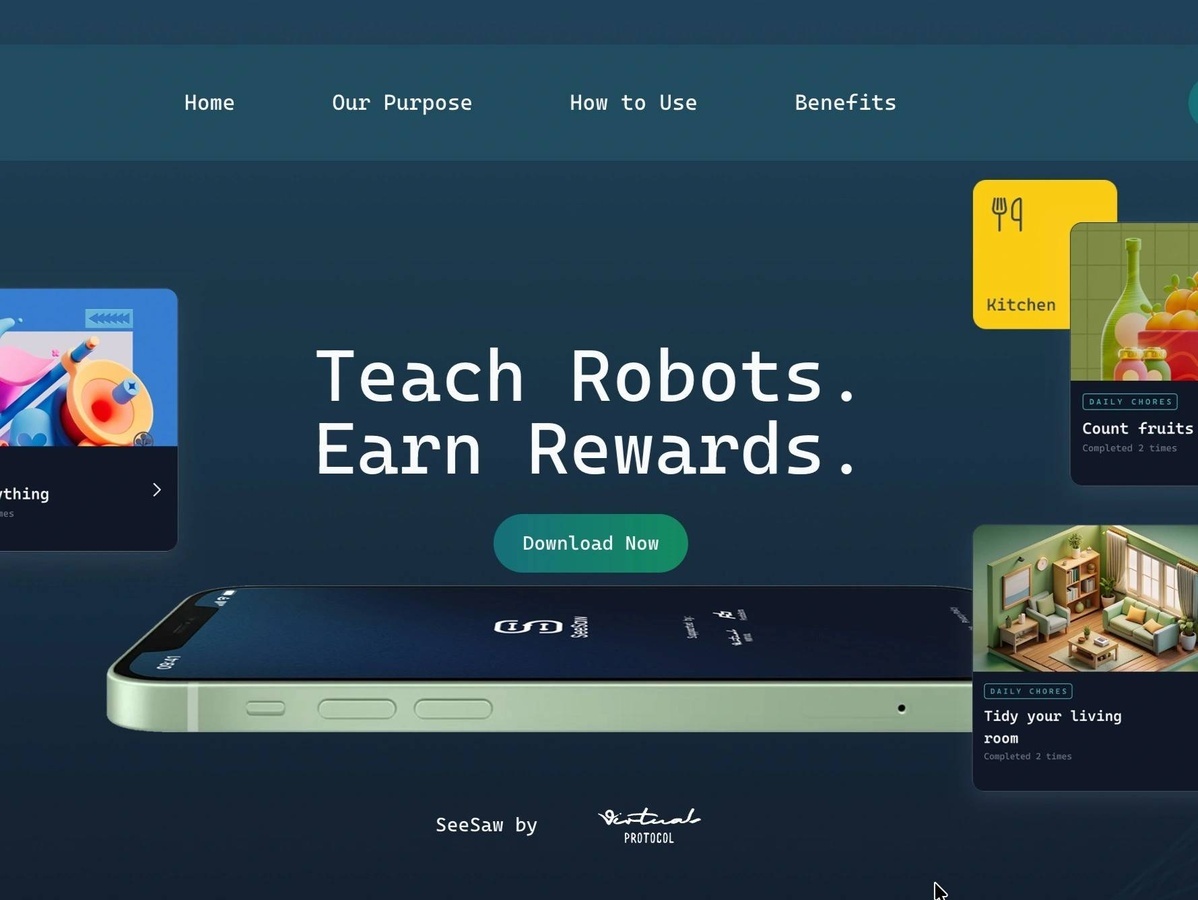
The platform's premise is elegantly simple: convert humanity's daily chores into machine training fuel. Through its mobile app, SeeSaw operates on a "Teach-to-Earn" model.
Users select from a list of micro-tasks, or "quests"—like making coffee or tying shoelaces. They record a short, first-person video of themselves completing the action and submit it via the app. Successful validation earns points, redeemable for merchandise and digital tokens.
This gamification is not a gimmick; it's a critical mechanism for sourcing the unscripted, nuanced behavioral data that simulations cannot replicate.
The Technical Backbone: BitRobot's Open Lab
SeeSaw doesn't operate in a vacuum. It functions as a specialized subnet (SN/05) within the BitRobot Network, an infrastructure project co-developed by FrodoBots Lab and Protocol Labs.
This integration provides the serious plumbing:
* Coordination: Managing a global, distributed network of contributors.
* Verification: Leveraging BitRobot's Verifiable Robotic Work (VRW) system to validate each submission for quality and utility.
* Rewards: Facilitating on-chain distribution of incentives.
BitRobot acts as the open robotics lab; SeeSaw is one of its most critical experiments.
Virtuals Protocol's Two-Pronged Strategy
SeeSaw was developed by Virtuals Protocol as the cornerstone of its "Virtuals Robotics" initiative. Their vision reveals a sophisticated understanding of the sector's twin failures: lack of data and lack of capital.
SeeSaw addresses the first. Its sister project, Unicorn, aims to solve the second by creating on-chain capital formation for robotics builders. Together, they form a intended flywheel: funding enables development, which requires data, which SeeSaw provides.
Incentives, Validation, and The Road Ahead
The "Earn" in "Teach-to-Earn" is multifaceted. Beyond immediate point redemptions, early contributors are building eligibility for future "network-wide rewards" across BitRobot. The validation step via VRW is crucial—it ensures the crowd-sourced dataset has measurable research value before any reward is issued.
The announced roadmap includes new quest categories, time-limited leaderboards, and subnet-wide challenges. This points to a focus on sustained engagement and dataset diversification.
The Bigger Picture: A Shift in AI Development
SeeSaw represents more than an app; it signals a shift in how we approach hard problems in AI. Instead of relying solely on curated lab data or synthetic environments, it leverages crypto-economic incentives to bootstrap a global, participatory data engine.
It asks: what if training data isn't just collected, but grown organically through aligned incentives?
Open Questions and Strategic Implications
The model is promising but untested at scale. Key questions remain:
* Can gamification sustain long-term, high-quality data contributions?
* How will data privacy and ownership be handled as the dataset becomes more valuable?
* Without its own native token (as of late 2025), how will SeeSaw's reward economy integrate with broader ecosystems?
For researchers and builders, access to this qualified egocentric video dataset could dramatically lower barriers to innovation in robot perception and manipulation.
Conclusion: Teaching Robots to Navigate Our World
SeeSaw’s ambition is to build the foundational dataset for physical AI. By bridging Virtuals' application-layer ingenuity with BitRobot's decentralized infrastructure, it creates a novel pipeline from human action to machine learning.
We are moving beyond teaching AI to think. Projects like SeeSaw are foundational to teaching it to do. The success of this crowdsourced approach could redefine not just robotics development, but how we collectively participate in building our automated future.
What mundane task will you teach a robot today?
Disclaimer: This article is for informational purposes only. It does not constitute financial advice, an endorsement of any project, or an inducement to participate in any rewards program. Readers should conduct their own thorough research before engaging with any digital platform or token economy.