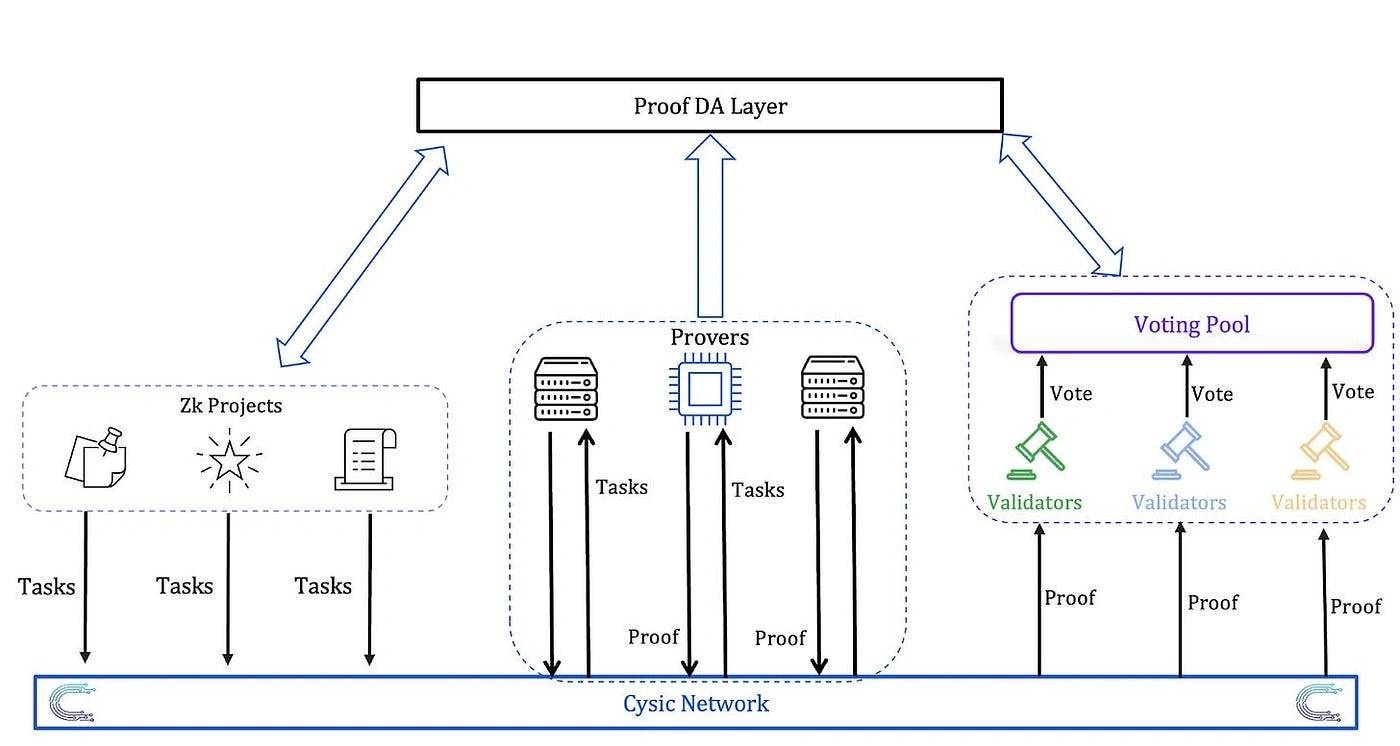
Cysic describes ComputeFi as a marketplace where providers contribute GPUs, CPUs, miners and specialized accelerators, while requesters buy computation and the network verifies results. The ambition is broader than faster zero-knowledge proofs: it is to make compute a measurable, tradable resource coordinated on-chain.
The useful way to evaluate that ambition is layer by layer. Hardware must perform, scheduling must allocate jobs, verification must detect incorrect results and incentives must make reliable capacity available when customers need it.
Key takeaways
- Cysic is building a full stack. The design combines hardware, workload coordination, verification and economic rewards.
- Different jobs require different proofs of correctness. ZK proving, AI inference and mining cannot all be verified in the same way.
- Specialized hardware may improve efficiency. Cysic documents a ZK chip, portable ZK-Air device and datacenter ZK-Pro system, with shipment expected in 2026.
- Published specifications are not production evidence. Buyers still need benchmarks, availability, pricing and failure data.
What ComputeFi is trying to coordinate
Providers register hardware, receive workloads and submit results. Requesters pay for useful compute. The network must then determine whether work was completed correctly and distribute compensation. Cysic proposes workload-specific mechanisms including cryptographic proofs, redundancy, consensus and conventional hash verification.
The hardware strategy
Cysic’s documentation describes ASIC hardware optimized for arithmetic used in zkSNARK and zkSTARK systems. ZK-Air targets local or portable proving, while ZK-Pro targets sustained datacenter workloads. The company states expected efficiency improvements over GPUs, but production buyers should wait for independently reproducible benchmarks on the exact proving system they use.
Potential users
Rollups and privacy systems need proof generation. AI developers may need inference with verifiable execution. Existing miners may seek additional workloads. Each user has a different service-level requirement: proof latency, model confidentiality, uptime, geographic constraints, software support and cost predictability.
Questions that separate a network from a narrative
- Which workloads are live and which remain planned?
- How is incorrect or unavailable compute detected and penalized?
- What benchmark can a customer reproduce?
- How are proprietary data and model weights protected?
- What capacity is available by hardware type and region?
- Does token compensation create durable supply when market prices change?
How to communicate ComputeFi
“Financializing compute” is a category story, not a buyer benefit. Buyers care about time-to-result, correctness, cost and operational support. Crynet helps infrastructure companies translate complex systems into evidence-led Web3 marketing that engineers and decision-makers can both understand.
This article distinguishes documented architecture from future product performance. It is not investment advice.