Crypto CRM & Lifecycle Marketing
Send the next useful message because of a known user state—not because a wallet or email exists in a list.
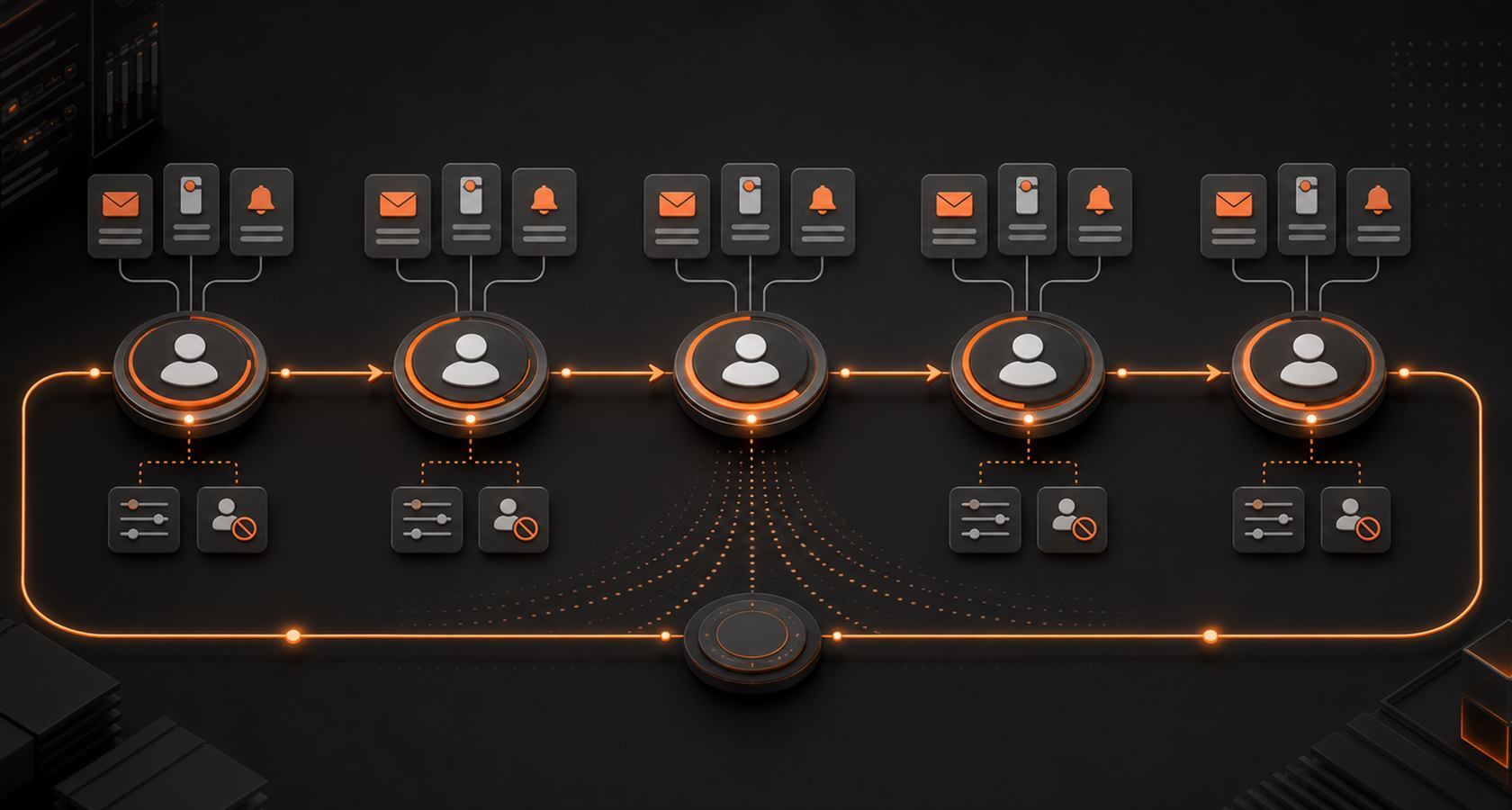
Overview
Lifecycle marketing begins with permission and state. An email address, wallet address, community handle and product account are not interchangeable identities, and an on-chain event does not automatically create permission for direct marketing.
Crynet builds an event-to-message system. Approved first-party events move users between defined states; each state has a need, message, channel, frequency rule, suppression condition and measurable next action. Onboarding, activation, retention and re-engagement remain visible parts of the same journey.
Data collection, identity resolution, consent and retention require owner approval. Crynet does not buy lists, scrape contact data or promise deliverability, retention or revenue. CRM implementation and complex data engineering are scoped separately.
Related work can connect with crypto onboarding content and crypto community management.
When This Channel Makes Sense
This engagement is useful when the team has a defined decision to make and the following conditions are present.
- Activation loss: New users register but fail to reach the first valuable action.
- Journey conflict: Product, support and marketing messages are uncoordinated.
- No segmentation: The team sends broadcasts without lifecycle segmentation.
- Education need: Users need education around security, features or product changes.
- Re-engagement risk: Re-engagement lacks consent, suppression and frequency controls.
- Event mismatch: CRM and analytics events use inconsistent definitions.
- Cohort blindness: Retention decisions depend on aggregate activity without cohort context.
What We Do
Data and journey audit: Lifecycle and first-party data audit.
State model: Stage, segment and key-action definition.
Permission rules: Consent, preference and suppression requirements.
Journey design: Onboarding, activation, retention and re-engagement journey design.
Trigger rules: Trigger, channel and frequency logic.
Message production: Message strategy, copy and creative specifications.
Automation support: CRM/automation implementation support.
Measurement design: Event, experiment and dashboard design.
Learning review: Deliverability, fatigue and journey-performance review.
What You Get
The lifecycle package may include:
Core working files.
Lifecycle map and KPI framework.
Segment and eligibility definitions.
Consent/preference/suppression specification.
Execution and governance.
Journey diagrams and trigger matrix.
Channel-ready message sequences.
CRM field and event requirements.
Measurement and handoff.
Implementation and QA checklist.
Experiment backlog.
Lifecycle dashboard and recurring findings.
The blueprint distinguishes a message sent, a message received and a product action; those denominators are never blended.
How the Campaign Works
- Data and permission audit. Establish sources, consent, purposes, access and current tooling.
- Lifecycle definition. Map stages, valuable actions, risks and exit conditions.
- Journey design. Define segments, triggers, channels, timing and suppression.
- Content production. Create approved messages and variants by lifecycle context.
- Implementation and QA. Configure or support automation, events and safeguards.
- Measurement and iteration. Analyze cohorts and experiments without claiming modeled correlation as certain causation.
Why Crynet
Crynet understands the fragmented identities and irreversible product moments that make Web3 lifecycle communication different from ordinary newsletters.
We connect each message to an approved state and evidence event, while preserving consent, frequency and suppression decisions.
The output can be reviewed jointly by product, marketing, support and privacy owners before a single automation is activated.
Campaign Parameters
How the work is verified. Every journey message records its trigger, user state, permitted channel, purpose, suppression rule and downstream event.
Evidence is separated into:
Permitted: the purpose, audience and channel basis are approved.
Triggered: a defined first-party event changes the user state.
Delivered: platform reporting records the attempted communication.
Acted: the next product or support event is measured without overstating causality.
External approvals, audience behavior and commercial outcomes remain outside Crynet’s control and are not guaranteed.
Useful first brief. Send the current URL or materials, target audience and markets, deadline, available evidence and the decision the work must support. Crynet will identify the smallest sensible first scope and the inputs still missing. Send the brief.
Frequently Asked Questions
What is Web3 lifecycle marketing?
It is the structured communication and product journey from onboarding through activation, retention and re-engagement for eligible users.
Is this cold email or wallet outreach?
No. This public service uses approved first-party relationships and channels. Cold or wallet-based outbound remains separately gated.
Which channels can be included?
Depending on permissions and product capability, journeys may use email, in-app messages, push, bots or other approved first-party channels.
What is the difference between service and marketing messages?
Service messages are necessary for the user’s requested product or account activity; promotional messages encourage additional commercial action. Classification affects consent and suppression requirements.
Can on-chain activity trigger a journey?
Public events may support product logic, but connecting a wallet event to a known user and marketing channel requires an appropriate first-party relationship and disclosed data practice.
Do you implement CRM automation?
Implementation support can be included after the approved data model, tool access and responsibility boundaries are defined.
How is retention measured?
Metrics depend on the product and may include activation, repeat feature use, cohort retention, re-engagement and qualified value events.
Can you guarantee higher retention?
No. Crynet can improve journey design and testing, while product value, market conditions and user choice remain decisive.
How are opt-outs handled?
Preference and suppression rules are designed into each eligible promotional journey and must be honored across connected tools.